Episode Transcript
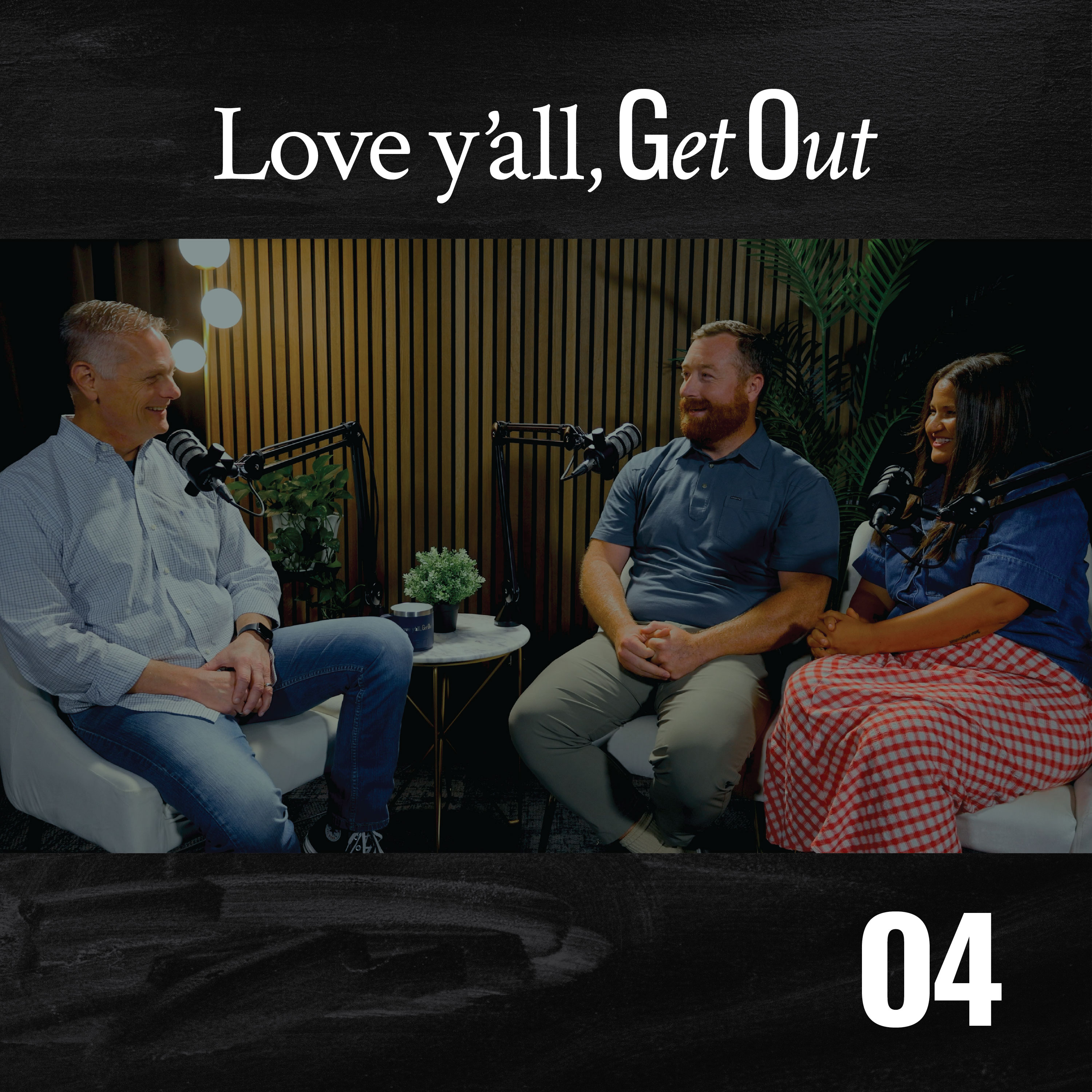
[00:00:15] Speaker A: Well, hey, everyone. Welcome to Love Y'. All. Get out. I'm so thankful that you've joined us today. My name is Chad and I'm your host. And. And I hope you'll subscribe to Catch future episodes because really, every time you press play, what you're going to get is something that will encourage and challenge your faith. And sometimes what we'll do, we'll do a deeper dive into Sunday's sermon. Sometimes we'll hear stories of faith from people in our community.
Sometimes we'll just talk church and the ideas and the decisions that we need to make in this community to really help us give strength to and gain strength from one another. So I'm thankful that you've joined us today. And today I have a special guest with me. This is my friend, Jim Breeze. Jim, thank you so much for being here today. I'm so glad that you could join us.
[00:00:56] Speaker B: Chad, it's a pleasure to be here. Always love being with you. I don't care where we are. Always fun to be with you.
[00:01:00] Speaker A: Well, I love being with you, and one of the reasons I love being with you is because I can always give you a hard time about. I think every piece of clothing you wear has a hog on it somewhere. You are. How did you become a Razorback fan?
[00:01:11] Speaker B: Well, I went to the University of Arkansas and.
[00:01:14] Speaker A: Well, that'll corrupt you every time.
[00:01:16] Speaker B: Yes, that. That took care of it. And it's never gotten out of my blood yet. I've spent most of my life in California, but I still am a Razorback at heart and always will be.
[00:01:29] Speaker A: Are you originally from Arkansas? Originally from Oklahoma. Where'd you come from?
[00:01:33] Speaker B: I was born in Hillcrest Hospital in Tulsa, Oklahoma, and spent my first year somewhere on Exanthus in Tulsa. I don't even know where that is, but that's where I lived my first year. And then my family moved to Siloam Springs, Arkansas, and that's where I grew up. And then, as I said, went on to the University of Arkansas and from
[00:01:52] Speaker A: there learned how to call the Hogs.
[00:01:54] Speaker B: I learned how to call the Hogs and a few other things in football
[00:01:58] Speaker A: that you cheer for the Razorbacks for about two games and then the rest of the season you cheer for the sec. Is that how that works?
[00:02:05] Speaker B: Well, you do that and then you say, we really a basketball school.
[00:02:08] Speaker A: Oh, well, there you go. And I think OU kind of has learned the, hey, let's cheer for the sec. And last season, I'm hoping we're having a better season this year. It happens and someday I'm going to get you to say Boomer out loud and really mean it.
[00:02:21] Speaker B: Don't think that's ever going to happen, Chad.
[00:02:23] Speaker A: Okay.
[00:02:24] Speaker B: Okay.
[00:02:25] Speaker A: You did mention that you've lived a lot of your life in California. Where did you live in California? What took you there?
[00:02:31] Speaker B: I went there when I got out of school. I went to work for an oil company here in Tulsa. And I thought I would live my life out in Tulsa. But that oil company was purchased by one in Philadelphia. And four or five years later, I decided I didn't want to move to Philadelphia. And so I left them and had a job opportunity in California, in Southern California, and moved out there and spent most of my life in Orange County, South Orange county of California.
[00:03:00] Speaker A: That's pretty cool. That's great. And I'm glad you've moved back to Oklahoma.
[00:03:03] Speaker B: I am, too.
[00:03:04] Speaker A: Back to the promised land.
[00:03:05] Speaker B: I'm probably happier than you are about it.
[00:03:07] Speaker A: That's always good. So while you were in California, you got to be part of something pretty special. Saddleback Community Church is the church that Rick Warren began. He's the author of the Purpose Driven Life, and it's really grown into a very influential church in our nation. And Rick Warren himself has. He's. He's advised kings and leaders and all kinds of people, business leaders and. And such. But you were a part of Saddleback. Tell me about that.
[00:03:35] Speaker B: That was a. A very interesting story. Saddleback, when we first started going, we were meeting first in schools, and then we finally got to where we could build something of our own on some property and put up some kind of a makeshift tent thing.
I remember in the wintertime, although California winters aren't like Oklahoma winters, but it would rain and get nasty, and we'd have to walk on boards through mud to get into the tent, and it would not be real comfortable.
But over the years, a beautiful campus has been developed there, and it's a showpiece. If you didn't even know it was a church, it's worth going to look at. But Rick did an amazing work at
[00:04:16] Speaker A: Saddleback, and it's right there in Orange County.
[00:04:18] Speaker B: It is. It was about a mile from my house.
[00:04:20] Speaker A: Wow, that's. And so when you.
You started in homes and then you went through tents, kind of the Wandering in the Wilderness church. Right.
You were at Saddleback at the very beginning.
[00:04:31] Speaker B: We were there. Not at the very, very beginning.
We were there probably maybe a year after Saddleback got off the ground, we went to another church there that was just kind of a community church. And they had some struggles and some differences of opinion. And when that church, whoever heard of such a thing?
But when that happened, that church kind of went different directions. And some of the real significant people at that church went to Saddleback Church. And to me, that's kind of when Saddleback really exploded.
[00:05:06] Speaker A: That's really interesting. And so you really got to experience Saddleback go from being a brand new congregation to really growing into, at some level, what it's become today.
[00:05:18] Speaker B: Yes.
[00:05:18] Speaker A: And you were a part of that.
[00:05:20] Speaker B: Yeah, it was fun to be a part of that. It was interesting.
A couple of Sundays ago, I ran into somebody at our church here that also was from Southern California. And she didn't remember me. We'd met once before, but I said, I went to church with you in California. She said, you did? And I said, we went to saddleback for probably 25 years. And I said, but we came in one door. You came in a different door. And if you didn't come in the same door at the same service, you. You went to church with a lot of people you never really saw, didn't know they were there.
[00:05:51] Speaker A: Wow, that's amazing. And, you know, that's one of the things that's just true about any church, is that there's just opportunities we have to attend church together and not always see each other, but we're constantly praying for and supporting one another and really trying to live out the same mission together. Whatever service we attend, whatever small group we're in. What's one of your most significant memories about your time at Saddleback and in California? What's something special?
[00:06:17] Speaker B: Oh, my gosh, there are a number of them.
One of the things that impressed me the most right off about Rick Warren, when we first started going there, we came out of church one day, and at that time we were meeting in the Tribuco High School gymnasium.
And we came out of there one day and Rick was outside waiting and he was greeting people and he said, hi, I'm Rick. And I said, I'm Jim. This is my wife, Kathy. And we went on, and the next Sunday we came out and when we walked out, he said, hi, Jim. Hi, Kathy. And there were probably three or four hundred people there that day. He had a memory for people's names that was just phenomenal. But one of the more fun things that I was able to do there was be in the Saddleback choir. And it was an experience that I'll never forget. It was really amazing.
[00:07:07] Speaker A: Would you be willing to sing something for us?
[00:07:09] Speaker B: Not right now.
[00:07:11] Speaker A: I think I'm thankful for that.
[00:07:13] Speaker B: I bet you are. I appreciate that.
[00:07:15] Speaker A: That's really good. Well, I'm really proud of the work that you did there in Saddleback, just as a church member and with what God's done in that place. I love what you do inside the life of our church. You're a deacon and a servant in the life of our church. You serve in our small groups. You serve in our corral. And I'm just. I'm thankful for that. It's amazing to see what God does when individuals really. That's what a church is, right? It's not really a building. It's not really an organization, though you have to be to get some things done. It's really people. It's the people of God called to one another, called to serve God in this community, in this generation, and really just using who they are and what they have to help bring glory to God, bring people to Jesus and help raise them up in that. So thank you.
[00:07:59] Speaker B: Absolutely.
[00:08:00] Speaker A: Thanks for doing that. That's really awesome.
You know, one of the priorities for our church, we think of it as a core value that we want to be a multi generational church. We want to be a congregation that equips people of all ages to serve one when it comes time to worship. We want to worship the God we love with the people we love and every stage of life. When I say generations, I don't necessarily mean Boomer, Millennial, Gen Alpha. I don't necessarily mean that. It's really that we all go through different stages of life, and each stage of life has its own challenges, and each stage of life has its own strengths.
And every generation has something they contribute. They can contribute, but they also have something that they need that. That would be a helpful way for us to interact with one another. And in the next few weeks, we're going to be doing a series called Influencers. And the idea that we can practice intentional influence with one another.
And I just believe and always have that something powerful happens when the wisdom of the mature and the experienced comes together with the passion and the vision of the young.
You know, you can go a long way with wisdom and experience, and you can go a long way with passion and vision.
But when you put those two things together, I think there's something really miraculous that happens. And so I want to foster that not just in the life of our church, but in the life of our community.
What are some things you've seen just in your life over time? Ways that people who are not in your generation, whether when you were younger, looking up to people who are older, or whether as you've matured and you're looking now at people in other generations, other stages of life, what are some things that you've seen that have just been encouraging to you?
[00:09:43] Speaker B: Oh, gosh, Chad, there's so many. I think the most encouraging thing for me is people just getting involved.
And so often we think, well, there's nothing. There's nothing I can bring to the table. I don't have a specific talent that I can bring.
And you mentioned a minute ago, would I sing you a song from set? I would not. I'm not going to sing you a song by myself, but I love singing with other people.
And we can all do that. We can all bring something to the table, but it just means getting up and doing it. So often we feel like, well, somebody else will take care of that.
And that's such an easy mindset to get into that we need to instead think, how can I help?
And that's kind of the way I look at things.
[00:10:30] Speaker A: That's really good. And I'll confess, I've heard you sing. You've got a great voice. With or without a choir, you'll do just fine. So I appreciate that. I think that's really good.
No matter what age or stage of life you're in, you do have something that you can contribute to your community. And really, that goes beyond our church.
I think serving in the church really matters and is really important.
But you've got a community of people and a community of believers around you in the place where you live, in your neighborhood, in your city.
And it's amazing what a difference is made when people just show up not with the intention of taking from one another, but with the intention of giving to one another. And so whether we're talking about the church or our community, that's really, really good. I love that. So with the generation you're in now and the people that you're surrounded with who kind of walk alongside you, whether it's in your small group here at church or out in the community, or just your friends and family, what do you think? For people who are in your stage of life, what do you think is the greatest thing they have to offer everyone else in every other stage of life?
[00:11:35] Speaker B: Well, that's a big question.
The obvious answer is wisdom.
We learn so much more by living than we do by reading.
And I think that's something that we lose some of if we had more of an interface with the younger part of the church.
And if we would listen to one another, that's the harder part.
We could all learn from each other. And I'm not saying my generation can teach them stuff, necessarily. We can, but they can teach us stuff as well.
If you want to know something about a cell phone, you don't ask somebody my age. You ask my grandson, who's 16.
It's just a different world that we live in than we grew up in. And we can share things, but we can learn things as well.
[00:12:27] Speaker A: Still, I sometimes have to remind my kids, whenever I'm doing something with technology, and they're like, dad, we don't do that anymore. Or sometimes it's with language. It's like with words like Drippy or Riz, where they're speaking their language and I'll drop one of their words and they'll just cringe and make fun of me. I like to remind them, you may know these things, but I taught you how to use a spoon.
And so you're not really as big as you think you are. So you're right. It's good to listen to each other. It's fun to tease each other. But there really are some things that each generation can just give generously to one another and. And the experience and the wisdom of people who have been there, there's such.
Such gravity in that. There's such value in that. And it would be a shame to lose the wisdom of that experience. It would be a shame to miss that just because we weren't hanging out together or we just weren't paying attention to one another or for some reason.
You know, with every generation, there's some strengths and weaknesses, and each one of them has a kind of arrogance sometimes about who they are. I can tell you with certainty that the music of the 80s is just better than all the other others.
[00:13:39] Speaker B: That's one area we're not going to get into.
[00:13:41] Speaker A: Yeah. And.
And it's funny because when I say that to my kids, they just shake their head and laugh, just like you did.
[00:13:47] Speaker B: Right.
[00:13:48] Speaker A: So here we are with that kind of. That kind of conversation. But one of the things you said just now really intrigues me if we would just take some time to be together.
And there is something about our world today that really makes it easy for us to gather together with people who are just like us. They're in the same stage of life as us. They think the way we think, they do the things we do. And there's nothing really inherently wrong with that. But there's such a privilege, such an influence, when we Take time to intentionally and deliberately come together with people who are different than we are. Whether it's about age or stage, or whether it's about interests, to just listen and learn from one another.
I appreciate that.
[00:14:29] Speaker B: I was thinking this morning, Chad, I wanted to mention to you two things that I think are pretty interesting considering my age, your age, your kid's age, my grandkids age. When I was the age of my grandson, maybe a few years younger than that, we had a phone that hung on the wall in the dining room of our house. A phone. One phone for the house.
And if I wanted to call my friend, which I did frequently, I would pick up the phone and a lady would answer and I would say, Mrs. Massey, will you connect me to Gordon? And she knew exactly who I was because she lived across the street from me. And that is so different. We finally got phones in Siloam Springs that had a rotary thing on them, but we still only had to dial five numbers.
But I think that is such a significant change from what the kids of today deal with. They're looking at the latest update, and if you don't have the latest update to your phone, you're nobody.
The other thing that I think is really interesting is that when I grew up in church, we sang out of a book. There was no screen on the wall. We sang out of a book. Now you can hardly find a book that's got songs in it. But those songs are still songs that people of my generation love to sing and hear.
And the younger generation, for the most part, has never even heard him.
[00:15:46] Speaker A: Yeah, it really is interesting. In the Psalms, David talks about how God writes a new song. And new songs are great. I love them. I want us to be a people who sing the best of the old songs with the best of the new songs. Because there's again, so much to be learned in all of that. And the books still exist. Even our worship team, the books, they use them. It's just on an iPad instead of actually a piece of paper that you flip through.
[00:16:11] Speaker B: Yeah. You can't open it and hold it.
[00:16:12] Speaker A: I remember in my generation, the Baptist hymnal, we both sang out of it and we used it to level the projector as projectors came in into play.
[00:16:20] Speaker B: That was. That was just multi purpose.
[00:16:22] Speaker A: Multi purpose, yes. It had lots of. Lots of uses, which is really good.
So in your stage of life. Every stage of life has things they can contribute, but there's also unique needs in every stage of life. If you were to look at people in other generations and say, here's something I wish you knew about us that just would be helpful if you just knew this and could help us with this. This would. That'd be really helpful. That'd be encouraging.
[00:16:47] Speaker B: You know, one of the things, Chad, that I hear, I've heard more than one time from my wife and other mostly women is that when they go to a department store and go past the cosmetics counter where they're wanting to try out new stuff or make their faces up or whatever, they used to get stopped all the time saying, hey, can we try out this new makeup on you? Or whatever. However it is they say it nowadays, they just kind of look through you. Oh, you're too old. We can't fix that.
We're not interested in even trying to fix that.
[00:17:19] Speaker A: I'm not going to go said, I can't fix that.
[00:17:21] Speaker B: You better not.
But I think. I think frequently people of my generation kind of feel like we're looked through or looked over as you're not terribly significant anymore.
And maybe that's partially our own fault for not having a bigger voice.
But I think the things that we worry about are our health, obviously, ending well, and financial strains because things have gotten so different from when we were in our earning years.
Things cost so much more.
Social Security can't keep up with that. And a lot of people of my generation struggle month to month to month, and you'd never know because they're still driving that nice car that they bought 20 years ago. It still looks good. Because that's another thing about my generation. We try to take care of them, but I think those things, health, finances, and just staying true to the course.
[00:18:20] Speaker A: Yeah, that's really. That's really good. And one of the things I notice when I have this same conversation with people in every generation, it's interesting because they don't all say it exactly the same way, but the topics are frequently the same. I just. I wish people would just see what my generation is capable of, and I wish they would see some of the things that would be helpful and just the needs that my generation has. I've teased, Londa, that now I'm too old to be cool and I'm too young to be wise, and I'm just stuck in the middle with you. Right. And so I'm not sure I've ever not felt that way whether I was a lot younger or whether I. Or as I get a lot older. The way the jokes roll are different. Right.
But I think that's interesting, just the idea that in your generation, you would Love for people to just see the potential that's there and to see the opportunity and the need that's there.
I think that's true for every generation. I don't think we talk to each other well enough.
[00:19:26] Speaker B: No, we don't. And I think part of that is there's really not a format for it.
We go to church in one room and the kids go to church in another room. When I grew up, we all went to church in the same room and we sang the same songs and we heard the same sermon or slept through it a lot of times, I'm sorry to say, but I think that's missing from a lot of churches as well. We segregate ourselves from the different age groups purposely because we think we're doing them a favor. But I think in some instances, we're not really. We need to have some time period where we all get together and we can all share.
[00:20:04] Speaker A: Yeah. And I'm not sure that that's really just a church problem. I see. You know, school is. It's natural for all the kids to go to school, and it's natural for all the adults to go to work. And then you get to enter that retirement stage where you're not doing all the. You're still doing work. You're just not doing the work that you've done. You're doing a different kind of work. But it really does. Not just in our church, but in our community. It puts us again right back around all the people who are kind of in the same stage of life as us. And so that thing that you said a minute ago, if we would.
With or without a program, with or without an excuse, if we would be the people who would be intentional about seeking out relationships with people who are in a different stage of life than us, maybe for a younger person, that's about seeking someone that you admire and think, you know, you're. You've. You've had some experiences that I've never had. Can I just talk to you about.
I don't know, life about. About things. It may be, if you're older, for you to pursue someone who's younger and say, hey, you know what? I see something. I see a lot of potential in you, and I would love to talk to you about that. Maybe. Maybe we could do that. Being intentional in that is so critical, and you really don't need an outside organization to make that happen for you can do that anytime. You could schedule lunch or breakfast or coffee with a friend who's in your community. You could take time to just meet together or to be together. And then inside our programmed moments, like what happens in our community or what happens in our church, we really can, as an organization, encourage that more. And so I want you to know that you have been one of those people to me, and I'm thankful for that. We're not in the same generation, and I admire who you are and the way you've lived your life. And we always get to tease each other a little bit.
[00:21:53] Speaker B: Yes, we do.
[00:21:54] Speaker A: And we joke a little bit. But I always walk away from our conversations encouraged and challenged and seen.
And I love that. So thank you so much for that, Chad.
[00:22:05] Speaker B: I can say the same thing. Obviously, I met you here at church, but I've been able to interact with you other places as well.
And I'm always amazed at your intellect, at your ability to be charming.
When you're really wanting to not be charming. You can say things in a charming way and get the point across. I just really enjoy spending time with you.
[00:22:28] Speaker A: I think that might be the first time I've ever been called charming, but I'm grateful for that.
[00:22:33] Speaker B: Good.
[00:22:33] Speaker A: I think that's awesome. That's awesome. Thanks so much. Thank you so much for your time today. My pleasure. I'm really, really grateful. And I'm grateful for you all, too. Over the next several weeks in our church services, we're going through a series called Influencers, and it's really about this topic. We're going to hit every age and stage of life. And just in terms of talking about how Scripture encourages us all to give strength to and gain strength from one another. And so thanks so much for joining us today. And like I said, I hope you'll subscribe so that you'll catch the next episode. And between now and then, love y'. All. Get out, Sam.